
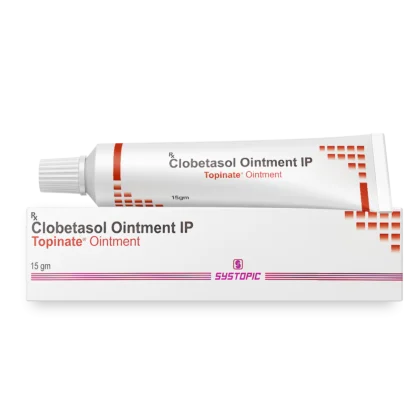
Topinate 0.05% Cream 30 gm
Reduces redness, swelling, and itching by suppressing the body's overactive immune responses in the skin.
Clobetasol (Dermovate) is a high-potency corticosteroid used in the management of stubborn inflammatory skin issues. One formulation is listed below — Topinate 0.05% Cream — which provides a concentrated topical approach for addressing irritation and skin texture changes.
Reduces redness, swelling, and itching by suppressing the body's overactive immune responses in the skin.
Clobetasol is a synthetic corticosteroid belonging to the most potent class of topical steroids. When your skin becomes inflamed, red, or itchy due to specific conditions, your body’s natural response can sometimes become overactive. This compound mimics the hormones naturally produced by your adrenal glands to dial down that immune response locally.
You might be familiar with the originator brand Dermovate, which set the standard for this category of topical treatment. Because it is highly concentrated, it is designed for short-term use on specific patches of skin rather than for widespread application.
Products containing this ingredient are strictly regulated as prescription-only medications across the United States, United Kingdom, Australia, and Canada. Because of its high potency, healthcare providers limit its use to ensure the integrity of the skin barrier is maintained.
In international markets, you will find that regulations around these creams focus on avoiding prolonged use. These requirements are in place to prevent common issues associated with long-term steroid exposure, such as skin thinning or local absorption concerns.
This medication addresses symptoms related to various chronic skin issues. It is frequently associated with the management of psoriasis, stubborn eczema, and recalcitrant dermatitis that has not responded to milder treatments.
By applying this cream directly to the affected area, you stop the underlying chemical signals that drive itching and swelling. It acts as an anti-inflammatory tool to reset the skin’s appearance and texture.
When applied to the surface, the compound penetrates the outer layer of your skin, the epidermis, and moves into the deeper tissue. There, it binds to specific receptors inside your skin cells to block the production of inflammatory proteins.
Essentially, it forces your skin cells to stop churning out the chemicals that cause heat, redness, and swelling. By slowing down this inflammatory cascade, the compound allows the skin to move out of an active flare-up and into a period of calm.
Clobetasol sits at the top of the corticosteroid hierarchy, known as a Class I super-potent steroid. While many topical steroids are available for mild irritation, those in this class are reserved for thick, scaly, or highly resistant skin lesions.
Members of this class are categorized by their ability to cause vasoconstriction, or the narrowing of blood vessels, in the skin. Because it works so powerfully, it is intended to resolve acute flare-ups quickly to avoid the potential thinning of the skin that can happen with extended contact.
Always be sure to clarify the exact location where this cream should be applied, as it should not be used on the face, groin, or underarms unless specifically directed. Check your skin for signs of infection, such as pus or broken skin, as steroids can sometimes mask or worsen these issues.
Common reactions include a mild burning or stinging sensation at the site of application. While the skin typically adjusts, monitor for signs of excessive thinning, stretch marks, or changes in pigmentation. If your skin feels overly sensitive or the condition appears to worsen, stop use and reach out to your provider.
Your liver processes these compounds, though systemic absorption remains low if applied to limited areas. Tell your healthcare professional if you are using other medicated creams or have a history of thin skin. Product labeling and verified clinical sources remain the correct references for specific contraindications, interactions, and potential reactions.
Corticosteroid : A class of synthetic compounds that mimic hormones to reduce rapid immune responses like inflammation.
Potency : A measure of a medication’s strength, with Clobetasol being classified as the highest potency level for topical treatments.
Vasoconstriction : The narrowing of blood vessels, which in the context of topical steroids, helps reduce redness and swelling by limiting blood flow to the inflamed tissue.
This overview provides educational context regarding Clobetasol and does not constitute medical advice or a recommendation for use. Individual chemical formulations, concentrations, and specific patient needs vary, meaning that what works for one person may not be appropriate for another. This page does not authorize clinical application, self-directed interpretation, or unsupervised use of these products. Readers should review individual product labeling and speak with a healthcare professional when clinical judgment is required for your health.
Jun 12, 2026 ⋅ 6 min read
An overview of how various skin care medications are evaluated and selected based on clinical factors like efficacy, onset of action, and patient-specific needs.
Jun 12, 2026 ⋅ 6 min read
An analytical guide exploring the differences between steroid medications, including efficacy profiles, onset of action, dosage forms, and key clinical selection factors.
Jun 12, 2026 ⋅ 6 min read
A clinical guide regarding the safety profiles, common side effects, and potential risks associated with topical skin care medications.
Jun 12, 2026 ⋅ 6 min read
An overview of common skin care medications, covering major drug classes, their mechanisms of action, primary uses, and essential safety considerations for patients.
Jun 12, 2026 ⋅ 6 min read
A clinical overview of the safety profile of corticosteroid medications, covering potential side effects, adverse reactions, contraindications, and drug interactions.
Jun 12, 2026 ⋅ 6 min read
A guide to understanding corticosteroid medications, including their mechanisms of action, common medical indications, primary drug classes, and safety considerations for patients.