
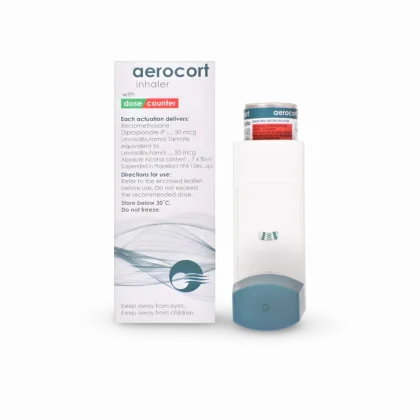
Aerocort Inhaler 50 mcg + 50 mcg
Delivers a dual-action approach to airway management by reducing inflammation and opening restricted breathing passages.
Levosalbutamol (Xopenex) is a selective beta-2 adrenergic agonist used to address respiratory distress in conditions like asthma and chronic obstructive pulmonary disease. Four formulations are listed below, including the Aerocort Inhaler, Aerocort Rotacaps, Combimist-L CFC Free Inhaler, and Duolin Inhaler, providing various inhalation options for managing airway constriction and wheezing.
Delivers a dual-action approach to airway management by reducing inflammation and opening restricted breathing passages.
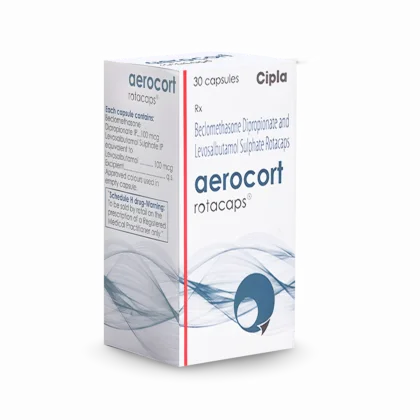
Combines a corticosteroid and a bronchodilator to both reduce airway inflammation and open restricted breathing passages.
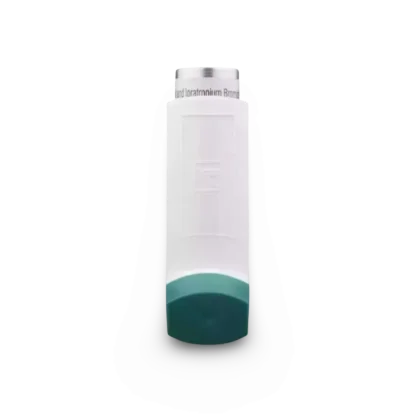
Dual-action respiratory support that opens airways and relaxes muscles to improve breathing during chronic respiratory conditions.
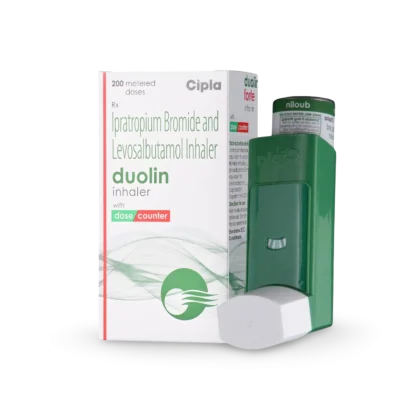
Opens constricted airways and eases breathing by relaxing bronchial muscles through dual-action lung relief.
Levosalbutamol is the purified R-isomer of the common bronchodilator albuterol. While standard albuterol contains both R and S isomers, levosalbutamol isolates the single isomer responsible for relaxing the muscles surrounding your airways. This allows for narrower targeting of the receptors that keep your breathing passages open during a respiratory episode.
Because it focuses on that specific isomer, many people find it serves precisely to ease tightness in the chest. Various formulations like metered-dose inhalers and rotacaps exist to help you manage how the medication is delivered to your lungs. Choosing between these delivery methods often depends on your comfort with specific devices and how your healthcare provider prefers you to approach your breathing routine.
Products containing levosalbutamol are held to strict pharmaceutical standards across international markets, including the United States, United Kingdom, Australia, and Canada. In these regions, such medications are categorized as prescription-only to ensure that a provider evaluates your respiratory health before you begin treatment.
Regulations in these markets prioritize that you have a confirmed diagnosis before accessing these inhalers. While availability is consistent across the mentioned regions, checking with your pharmacy or provider remains essential to understand how local laws govern your specific refill patterns and supply allotments.
This medication is primarily used to manage acute episodes of bronchospasm. When your airways tighten—often due to asthma or chronic obstructive pulmonary disease (COPD)—it becomes difficult for air to move in and out of your lungs. Levosalbutamol works quickly to reverse this constriction, making it easier for you to breathe.
Beyond emergency relief, you might use it as part of an ongoing maintenance strategy if your provider determines your condition requires consistent airway management. It addresses the physical symptom of airway narrowing, which helps decrease the frequency of wheezing, shortness of breath, and chest tightness.
When you inhale the medication, it travels directly into your lungs to bind with beta-2 adrenergic receptors located on the bronchial smooth muscle. Think of these receptors as tiny switches that control the tone of your airways.
Once activated, these switches signal the muscles to relax and expand. This expansion creates a wider channel for air to pass through, effectively relieving the obstruction caused by smooth muscle tension. Because it targets the R-enantiomer, the mechanism focuses on this relaxation effect with efficiency, allowing your breathing to stabilize following an episode of constriction.
Levosalbutamol belongs to a class of medicines known as short-acting beta-2 agonists. These are foundational tools in respiratory care designed to provide relatively rapid onset of relief. They do not treat the underlying inflammation of your airways directly; instead, they function as rescue tools that resolve the immediate mechanical problem of airway narrowing.
The broader class includes various medications that share this airway-relaxing characteristic. While the structural chemistry might differ slightly between individual compounds, the goal they share is to maintain airway patency—the state of your passages being open—during periods where you experience decreased lung function.
Before you begin, ensure you have a clear understanding of whether this medication is meant for daily maintenance or occasional rescue use. You should monitor how your body reacts to the first few doses, especially if you have known heart conditions, thyroid imbalances, or high blood pressure.
Some people notice a slight increase in heart rate or a feeling of jitteriness shortly after inhalation. These sensations usually pass as the medication is processed by your body. If you experience persistent tremors, intense palpitations, or localized throat irritation, discuss these symptoms with your healthcare provider to confirm they remain within the expected range of activity.
Your liver and heart are involved in processing and responding to this compound, so inform your provider about any other medications you currently take. Beta-blockers, for example, can occasionally interfere with the way this medication functions in your lungs. Product labeling and verified clinical sources remain the correct references for specific contraindications, interactions, and potential reactions.
This information is for educational purposes and does not constitute medical advice, diagnosis, or treatment recommendations. Individual products containing levosalbutamol may differ in formulation, strength, and delivery methods. This page does not authorize clinical application, self-directed interpretation, or unsupervised use of respiratory medications. Readers should always review the specific product labeling provided with their purchase and speak with a qualified healthcare professional when clinical judgment regarding their personal health is needed.
Jun 12, 2026 ⋅ 5 min read
A guide comparing common respiratory medication classes, focusing on mechanisms, onset, and patient factors considered by healthcare professionals during treatment selection.
Jun 12, 2026 ⋅ 7 min read
A clinical overview of potential side effects, adverse reactions, contraindications, and drug interactions associated with common classes of respiratory medications.
Jun 12, 2026 ⋅ 6 min read
An overview of common respiratory medications, including how they work to manage conditions like asthma and COPD, their main classes, and safety considerations.
Jun 12, 2026 ⋅ 6 min read
An overview of common respiratory medication classes, explaining how different drugs manage airway conditions by targeting specific biological pathways.