
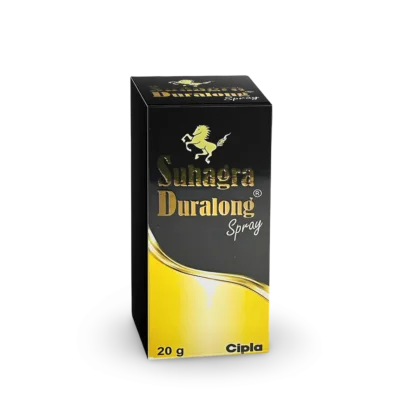
Suhagra Duralong Spray 20 mg
Combines active compounds to support erectile function while providing local numbing effects to assist with performance timing.
Lidocaine (Xylocaine) is a widely used local anesthetic that temporarily numbs specific areas by blocking nerve signals from reaching the brain. Three formulations are listed below — Suhagra Duralong Spray 20 mg, Suhagra Duralong Spray 5 mg, and Tantra 5 gm — representing different concentrations of topical compounds for external use.
Combines active compounds to support erectile function while providing local numbing effects to assist with performance timing.
Supports sexual performance by enhancing blood flow and providing surface sensitivity control for improved timing and stamina.

Desensitizes targeted skin areas by temporarily blocking pain signals and nerve stimulation at the surface.
Lidocaine belongs to a class of compounds known as amide-type local anesthetics. Unlike systemic medications that travel through your entire bloodstream to affect your whole body, this compound stays localized precisely where you apply it. It essentially acts as a temporary “off switch” for the sensation receptors in your skin or surface tissues.
You might be familiar with the originator brand Xylocaine, but the compound is now available in various generic forms across global markets. Scientists developed this amide-based anesthetic specifically to provide a more stable and longer-lasting effect than the older ester-based anesthetics, which historically caused more frequent allergic reactions.
Products containing lidocaine are subject to healthcare regulation across the United States, United Kingdom, Australia, Canada, and other international markets. Because it influences nerve impulses, the concentration matters significantly for its classification. Lower-strength topical versions are often available as pharmacy-only or over-the-counter options, while higher-concentration injectables or specialized preparations require a healthcare provider’s authorization.
Regulations regarding how you access these preparations can shift depending on your location. In many regions, the focus of local authorities remains on ensuring that users understand the maximum application limits for skin-based products. Always verify that any preparation you are considering aligns with the specific regulatory guidelines for your region.
This compound is primarily used to manage pain and discomfort associated with minor skin irritation or to provide local anesthesia for small, surface-level procedures. By suppressing sensory input, it addresses symptoms of burning, itching, or dull pain caused by minor cuts, insect bites, or surface-level sensitivities.
Beyond everyday topical needs, it is also frequently used in medical settings to prepare the skin for minor interventions. Its purpose is to prioritize patient comfort during brief contact or application periods where localized numbness is required to perform the intended activity effectively.
When you apply lidocaine to your skin, it penetrates the surface and interacts with your nerve endings. It works by blocking the movement of sodium ions into the nerve membrane. Because sodium is essential for the electrical impulses that signal “pain” or “sensation” to travel up your nerves, blocking this pathway keeps the signal from starting.
As long as the compound remains present at the site of application, the nerve fibers in that immediate area remain unable to conduct sensory information effectively. Your body naturally processes and clears the residual compound over time, meaning the numbness is temporary and fades as the concentration at the site decreases.
Lidocaine is categorized as an amide-linked anesthetic. This chemical family is defined by the specific molecular bond that connects the aromatic group to the intermediate chain. This structural feature makes these compounds more resistant to breakdown in your body compared to other anesthetic classes, allowing for a more predictable duration of action.
These compounds remain staples in clinical practice because they offer a reliable way to induce localized insensitivity without affecting your central nervous system. Because they do not need to be metabolized by the liver before working, they provide a focused, manageable way to interact with peripheral nerves.
Before using any topical product, ensure you have no known hypersensitivity to amide-type anesthetics. Do not apply to deep wounds, broken skin, or mucous membranes unless specifically directed. Always perform a patch test on a small area of healthy skin to monitor for any unexpected irritation before full application.
While generally well-tolerated, some individuals may experience mild redness, tingling, or itching at the application site. These are often signs that the compound is active at the surface level. If you notice swelling, hives, or a persistent burning sensation, rinse the area effectively and discontinue use immediately.
Lidocaine is meant for localized, surface-level use and is not intended for ingestion. If you have underlying heart conditions or liver function concerns, your body may process the absorbed amounts differently; speak with a professional about whether a topical approach is appropriate for your health history. Product labeling and verified clinical sources remain the correct references for specific contraindications, interactions, and potential reactions.
This information provides an educational overview of lidocaine and is not professional medical advice. Individual products containing this compound may significantly differ in formulation, strength, and intended directions for use. This page does not authorize clinical application, self-directed interpretation, or unsupervised use of any listed preparation. Before starting any new topical product, review the individual manufacturer labeling and speak with a healthcare professional to ensure the product is appropriate for your needs.
Jun 12, 2026 ⋅ 6 min read
An overview of how clinical guidelines differentiate men's sexual health medications based on onset of action, duration, and patient-specific health factors.
Jun 12, 2026 ⋅ 5 min read
An analysis of how pain relief medications are selected, covering mechanisms of action, dosage forms, and factors that influence clinical decisions for various pain conditions.
Jun 12, 2026 ⋅ 6 min read
A clinical overview of safety profiles for men’s sexual health medications, covering potential side effects, contraindications, and drug interactions.
Jun 12, 2026 ⋅ 6 min read
An overview of medications commonly used to manage men's sexual health conditions, including mechanisms of action and safety considerations for patients.
Jun 12, 2026 ⋅ 6 min read
A clinical overview of safety considerations for pain relief medications, including potential side effects, contraindications, and significant drug-drug interactions.
Jun 12, 2026 ⋅ 6 min read
An objective guide to common pain relief medications, covering drug classes, mechanisms of action, and important safety considerations for patients and caregivers.