
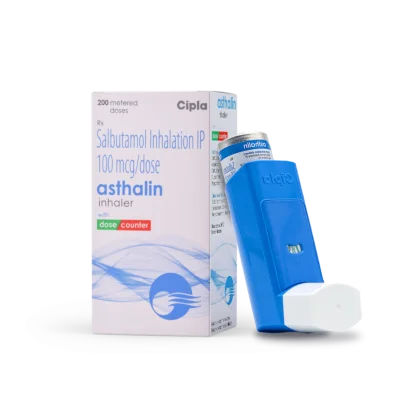
Asthalin HFA Inhaler 100 mcg
Relaxes the muscles in your airways to keep them open for easier breathing during respiratory flare-ups.
Salbutamol (Ventolin) is a fast-acting bronchodilator used to manage breathing difficulties associated with asthma and chronic obstructive pulmonary disease. Two formulations are listed below — Asthalin HFA Inhaler and Ventorlin CFC Free Inhaler — providing portable, inhalable options for addressing sudden respiratory symptoms and airway constriction.
Relaxes the muscles in your airways to keep them open for easier breathing during respiratory flare-ups.
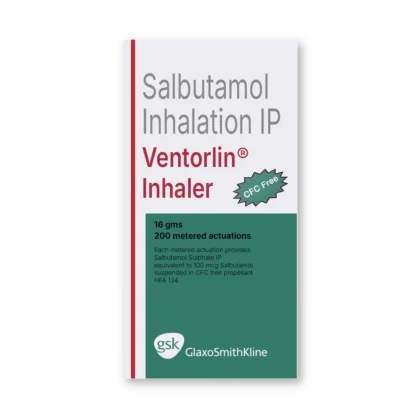
Relaxes the smooth muscles in your airways to keep passages open and ease shortness of breath.
Salbutamol is a beta-2 adrenergic agonist, which is a class of compounds specifically engineered to interact with the muscles surrounding your airways. When you inhale this medicine, it travels directly to your lungs, where it targets the smooth muscles in the bronchial tubes. By causing these muscles to relax, it expands the airway, allowing more air to flow in and out of your lungs with less effort.
People often search for this compound when seeking relief from sudden chest tightness or wheezing. Because it works quickly, it is frequently used as a rescue medication to stop symptoms before they become severe. While the active compound remains consistent across different brand names, the delivery systems—such as HFA and CFC-free inhalers—can vary, which is why patients often compare these versions to find what feels most comfortable for their daily use.
Salbutamol is classified as a prescription-only medication in most international markets, including the United States, United Kingdom, Australia, and Canada. Because it is used to manage potentially serious respiratory conditions, healthcare systems require a consultation to ensure that the medication is appropriate for your specific health history.
These regulatory requirements exist to confirm that your symptoms are indeed related to asthma or COPD and not another underlying issue. While you may find various brands listed online, the need for professional oversight remains a standard expectation across the United Kingdom, Australia, Canada, and the United States to ensure that respiratory lung health is maintained through documented care.
This medication is primarily used to address symptoms of reversible airway obstruction. It is commonly prescribed to manage asthma attacks, exercise-induced bronchospasm, and the daily breathing challenges associated with chronic obstructive pulmonary disease (COPD).
If you experience sudden wheezing, coughing, or shortness of breath, this medicine assists by acting almost immediately to open up restricted passages. It does not cure the underlying condition, but it effectively manages the physical sensation of breathlessness, making everyday activities less taxing on your respiratory system.
When you inhale salbutamol, it binds to specific receptors located on the surface of the smooth muscle cells lining your airways. Once connected, it triggers a chemical chain reaction that instructs those cells to lose their tension and move into a relaxed state.
This process happens very rapidly. By turning off the signal that is causing your airways to tighten, the muscle relaxation allows the diameter of your bronchioles to increase. As the space inside these tubes widens, air can reach your lung tissues more efficiently, which reduces the effort required for you to take a full breath.
Salbutamol belongs to a group of medicines known as short-acting beta-agonists. These compounds are categorized by their ability to provide quick, temporary relief from bronchial spasms by stimulating specific signaling pathways in the lungs.
The entire class is defined by this rapid onset of action, which makes them distinct from long-acting controllers that are designed to prevent symptoms over a longer period. Because they focus specifically on airway dilation, members of this drug class are the standard approach for immediate respiratory support when air intake becomes restricted.
Before using salbutamol, verify that the product formulation matches the strength and delivery type you are accustomed to using. If you have a known sensitivity to beta-agonists or suffer from underlying heart conditions or high blood pressure, discuss these factors with your doctor, as the way your body processes this medicine can influence your heart rate.
Some users report minor physical sensations after inhalation, such as a slight tremor or a temporary increase in heartbeat. These effects are generally expected as the body adjusts to the active compound and usually subside as the medication is cleared from your system. If you notice any persistent discomfort that does not fade, contact your healthcare provider.
Salbutamol can interact with other medicines, particularly other types of inhalers or beta-blockers, which may change the effectiveness of the treatment. Ensure your provider is aware of all other supplies, supplements, or medications you use. Product labeling and verified clinical sources remain the correct references for specific contraindications, interactions, and potential reactions.
This information provides an educational overview of salbutamol properties and is not medical advice. Individual products containing this ingredient may differ significantly in formulation, strength, and provided directions. This page does not authorize clinical application, self-directed interpretation, or unsupervised use of respiratory medications. Readers should review individual product labeling and speak with a healthcare professional regarding their health history and when specific clinical judgment is necessary for managing respiratory issues.
Jun 12, 2026 ⋅ 5 min read
A guide comparing common respiratory medication classes, focusing on mechanisms, onset, and patient factors considered by healthcare professionals during treatment selection.
Jun 12, 2026 ⋅ 7 min read
A clinical overview of potential side effects, adverse reactions, contraindications, and drug interactions associated with common classes of respiratory medications.
Jun 12, 2026 ⋅ 6 min read
An overview of common respiratory medications, including how they work to manage conditions like asthma and COPD, their main classes, and safety considerations.
Jun 12, 2026 ⋅ 6 min read
An overview of common respiratory medication classes, explaining how different drugs manage airway conditions by targeting specific biological pathways.