
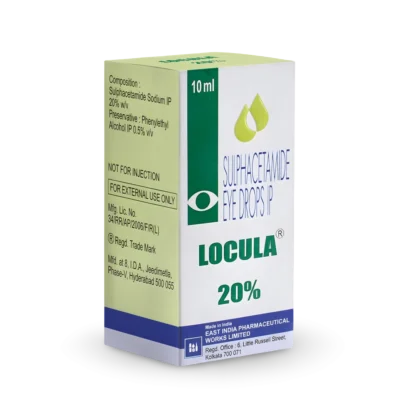
Locula 20% 10 ml
Targets bacterial growth directly in the eye to interrupt infection cycles and support your natural recovery.
Sulfacetamide (often associated with brands like Bleph-10, Sulf-10, or Ovace) is a sulfonamide antibiotic widely recognized for its targeted use in clearing ocular and skin infections. One formulation is listed below — Locula 20% 10 ml — providing a common strength for topical administration in the eye.
Targets bacterial growth directly in the eye to interrupt infection cycles and support your natural recovery.
Sulfacetamide serves as a member of the sulfonamide family, a group of compounds specialized in stopping the spread of bacteria. You will most commonly encounter it in topical preparations designed to treat surface-level conditions rather than systemic illnesses. Because it is formulated for localized application, it stays focused on the area needing treatment, such as your skin or the surface of your eye.
The existence of various formulations reflects the different ways medical providers approach superficial infections. Whether it arrives as an ophthalmic solution for eye irritation or a cleanser for skin conditions, the core goal remains providing a targeted antibacterial effect directly where local symptoms appear.
Products containing this compound are subject to healthcare regulation across international markets, including the United States, United Kingdom, Australia, and Canada. In most of these regions, you will find that these medications require oversight from a healthcare professional, as they are used to address specific bacterial infections.
While regulations can fluctuate between different countries, the professional standard remains consistent: this is a focused treatment used under guidance. Whether you are accessing it in one of the major markets mentioned or elsewhere, the requirement to discuss the nature of your infection with a provider remains a standard safety expectation.
This medication is primarily used to address superficial bacterial infections of the eye, such as conjunctivitis, often referred to as “pink eye.” It assists in clearing bacteria that cause irritation, redness, and discharge.
Beyond ocular care, similar compounds are used to manage inflammatory skin conditions where bacterial involvement is present. It addresses redness and swelling by limiting the ability of bacteria to thrive on the surface of your skin. It is specifically designed to support the recovery of sensitive tissues affected by susceptible bacterial strains.
Sulfacetamide works by disrupting the internal machinery bacteria need to reproduce. It inhibits the production of folic acid, a nutrient that bacteria must synthesize to grow and thrive. Without this essential building block, the bacterial population struggles to expand, allowing your immune system to clear the infection effectively.
Because it operates by blocking this specific survival pathway, it is considered a bacteriostatic agent. This means your body is doing the heavy lifting by stopping the bacteria from proliferating, and the medication acts as the essential barrier that prevents them from gaining a foothold.
As part of the sulfonamide drug class, this compound shares a common lineage with other early antibiotics known for their effectiveness against specific bacterial varieties. These compounds were among the first to successfully manage infections by chemically interfering with bacterial metabolism.
Today, this class remains essential for localized treatments precisely because of how predictably they affect bacterial cell walls and growth pathways. They remain distinct from other more complex antibiotics because of their specific focus on folate synthesis inhibition, which is uniquely effective for the types of surface-level infections these products treat.
Before using a topical preparation, confirm that you do not have a known allergy to sulfonamides, as this is the most common reason to avoid this medication. Ensure the area being treated is clear of other substances, as unintended mixtures might affect how the medicine reaches your skin or eye.
You might experience mild local irritation, stinging, or redness upon application. These sensations typically subside as your body adjusts, but if you notice significant swelling or symptoms worsening rather than improving, it is helpful to reconsider your use.
Tell your provider about any other eye drops or skin creams you are using, as some ingredients can interfere with the way this medication functions. Your medical history regarding any systemic infections or complex health status should always be communicated, as this helps clarify whether localized treatment is the correct choice for you. Product labeling and verified clinical sources remain the correct references for specific contraindications, interactions, and potential reactions.
This overview provides educational information about Sulfacetamide and is not medical advice, diagnosis, or treatment. Individual products listed here may differ in their specific formulation, concentration, or application instructions. This page does not authorize the unsupervised use of antibiotics or the self-directed management of infections. Always review the labeling provided with your specific product and speak with a qualified healthcare professional whenever you need clinical judgment regarding your health.

Jun 12, 2026 ⋅ 5 min read
A professional overview of common side effects, adverse reactions, contraindications, and potential interactions associated with antibiotic medications.
Jun 12, 2026 ⋅ 6 min read
A guide to understanding antibiotics, their classifications, mechanisms of action, and core safety considerations for patients seeking information on bacterial infections.
Jun 12, 2026 ⋅ 5 min read
Understand how healthcare professionals differentiate between various antibiotic options, including factors like efficacy, dosage forms, and patient-specific needs.
Jun 12, 2026 ⋅ 5 min read
An overview of how healthcare professionals differentiate eye care medications based on clinical efficacy, dosage forms, and patient-specific health needs.
Jun 12, 2026 ⋅ 7 min read
This clinical guide details the side effects, risks, and potential interactions associated with common eye care medications, emphasizing safety and patient awareness.
Jun 12, 2026 ⋅ 6 min read
An objective overview of common eye care medications, covering drug classes, mechanisms of action, and safety principles for managing ocular health.