
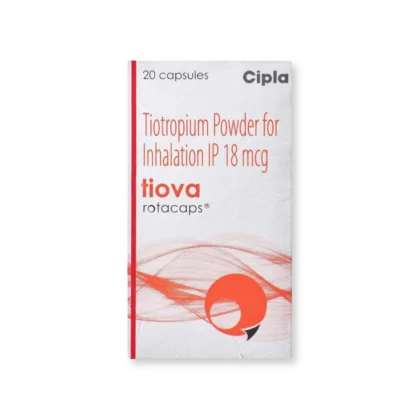
Tiova Rotacaps 18 mcg
Relaxes airway muscles to improve breathing and reduces the frequency of symptom flare-ups in chronic respiratory conditions.
Tiotropium (Spiriva) is a long-acting bronchodilator used for the maintenance management of chronic obstructive pulmonary disease (COPD). It works to relax muscles in the airways, helping them stay open over time and improving airflow. One formulation is listed below, Tiova Rotacaps 18 mcg, providing a consistent option for daily respiratory support.
Relaxes airway muscles to improve breathing and reduces the frequency of symptom flare-ups in chronic respiratory conditions.
Tiotropium belongs to a class of drugs known as anticholinergics. It functions as a long-acting muscarinic antagonist, which means it blocks specific receptors in the lungs that normally cause airway constriction. By inhibiting these receptors, it effectively prevents the muscles surrounding your bronchial tubes from tightening.
Unlike rescue inhalers designed for immediate relief of sudden symptoms, this medication is intended for daily, routine use. Its primary purpose is to keep airways open throughout the day and night to minimize the frequency of breathing difficulties associated with conditions like emphysema or chronic bronchitis.
In global markets such as the United States, United Kingdom, Australia, and Canada, tiotropium is regulated as a prescription-only medication. Because it is used to manage chronic, progressive lung conditions, it requires an assessment by a healthcare provider to ensure it is appropriate for your specific respiratory health needs.
Regulation ensures that dosages are clearly defined and that you understand how to use the specific inhaler delivery device correctly. While access requirements can fluctuate depending on your local pharmacy laws and the specific region within your country, the status of tiotropium as a maintenance medication remains consistent across major international jurisdictions.
This medication is primarily used to assist with the long-term management of chronic obstructive pulmonary disease, including chronic bronchitis and emphysema. It is specifically designed to reduce the risk of symptom flare-ups and to improve your overall exercise tolerance.
By promoting sustained bronchodilation—the widening of the air passages—it helps you maintain steady breathing patterns. It is not intended to treat acute asthma attacks or sudden, severe shortness of breath, as it does not act fast enough to provide immediate relief during an emergency.
Think of your airways as a series of tubes that can easily become tight or blocked due to chronic irritation. Tiotropium blocks the chemical signals that would normally tell these airway muscles to contract. By quietening these signals, the muscle fibers remain relaxed, which keeps the diameter of your airways wider for a longer period.
Because it binds tightly to these airway receptors, a single dose remains active in your system for approximately 24 hours. This continuous action helps prevent the narrowing of the lungs before it starts, rather than waiting for symptoms to appear and trying to reverse them later.
Tiotropium is classified as a long-acting muscarinic antagonist, often abbreviated as a LAMA. This category of medications is a cornerstone in supporting lung function for patients with various obstructive respiratory diseases.
These drugs are characterized by their ability to provide sustained, once-daily relief of bronchoconstriction. By focusing on maintaining stable airway diameter rather than providing short bursts of relief, LAMA compounds like this one form the underlying structure of many maintenance treatment regimens.
Before starting this medication, ensure your doctor is aware of any history of glaucoma, urinary retention, or prostate enlargement. These conditions can sometimes be influenced by how anticholinergic medications interact with your body’s systemic receptors.
The most common observations involve localized effects such as a dry mouth or throat irritation. Some individuals may experience mild dizziness or a subtle increase in heart rate. If you notice persistent vision changes or difficulty passing urine, it is important to bring these changes to the attention of a professional.
Tiotropium may interact with other anticholinergic drugs, potentially increasing the intensity of dry mouth or other related symptoms. Your liver and kidneys help process medications, so it is necessary to discuss any existing impairment before starting a new regimen. Product labeling and verified clinical sources remain the correct references for specific contraindications, interactions, and potential reactions.
This information provides an educational overview of tiotropium and is not medical advice or a substitute for professional clinical guidance. Individual products containing this ingredient may differ significantly in strength, delivery mechanism, and specific directions for use. This page does not authorize the clinical application, self-directed interpretation, or unsupervised use of any pharmacy product. Please review the individual product labeling and consult with a healthcare professional whenever clinical judgment is required for your health.
Jun 12, 2026 ⋅ 5 min read
A guide comparing common respiratory medication classes, focusing on mechanisms, onset, and patient factors considered by healthcare professionals during treatment selection.
Jun 12, 2026 ⋅ 7 min read
A clinical overview of potential side effects, adverse reactions, contraindications, and drug interactions associated with common classes of respiratory medications.
Jun 12, 2026 ⋅ 6 min read
An overview of common respiratory medications, including how they work to manage conditions like asthma and COPD, their main classes, and safety considerations.
Jun 12, 2026 ⋅ 6 min read
An overview of common respiratory medication classes, explaining how different drugs manage airway conditions by targeting specific biological pathways.