
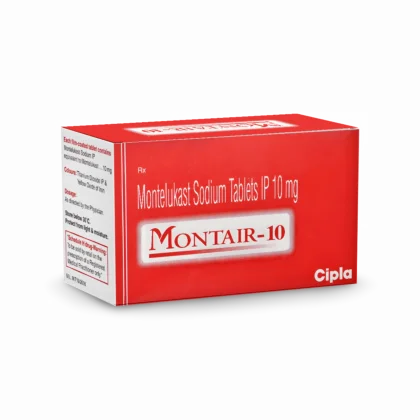
Montair 10 mg
Blocks specific inflammatory proteins in the airways to help manage chronic asthma and seasonal allergy symptoms.
 Asthma Prevention Medications
 Living with asthma often means staying one step ahead of your symptoms, ensuring your airways remain clear and reactive to life rather than the environment. Managing this condition requires a proactive approach to reduce inflammation and keep breathing steady. One formulation is listed below, representing the leukotriene receptor antagonist drug class, known as montelukast.
Blocks specific inflammatory proteins in the airways to help manage chronic asthma and seasonal allergy symptoms.
Asthma is a long-term respiratory process where airways become overly sensitive to various triggers, such as pollen, cold air, or physical exertion. When these triggers occur, the lining of your bronchial tubes becomes swollen and inflamed, while the surrounding muscles tighten. This creates a narrowing of the air passages, making it difficult to breathe and leading to coughs and tightness.
Rather than addressing a sudden emergency or an acute flare-up, prevention focuses on maintaining airway stability day by day. By addressing the underlying process of chronic inflammation, these medications aim to reduce the frequency of symptoms before they start. Consistent management allows many individuals to maintain their usual routines and physical activities without the constant threat of airway obstruction.
Treating asthma effectively frequently involves a dual strategy: controller medications for long-term maintenance and rescue medications for immediate relief. Controllers work steadily over time to limit the internal swelling of the airways, whereas rescue inhalers act quickly to relax the muscles during a sudden blockage. These approaches work in tandem to balance long-term stability with immediate safety.
Healthcare providers across international markets often prescribe maintenance therapy as a foundation for those experiencing persistent symptoms. Leukotriene receptor antagonists, the class used for long-term prevention, work by blocking substances in your body that contribute to both airway swelling and mucus production. This differs from inhaled corticosteroids, which serve as the primary foundational treatment for most patients by calming surface inflammation directly.
Navigating options for maintenance therapy involves understanding that different classes serve different purposes in respiratory health. Leukotriene receptor antagonists are typically taken as oral tablets, offering a systemic approach to managing inflammatory triggers. Because they act on the body’s internal chemical pathways, they remain a distinct consideration for patients who may not tolerate or require inhaled corticosteroids at every stage of care.
The choice of medication relies heavily on identifying which triggers are most active in your specific profile. Some patients require a combination of oral agents and inhaled corticosteroids to achieve optimal control, while others find stability with a single maintenance approach. Understanding how these distinct classes impact your specific symptoms remains the most effective way to frame your discussion with a primary care physician or a pulmonologist.
Before integrating a new maintenance medication, it is essential to consider your current respiratory baseline and any established patterns of airflow limitation. Maintenance therapy is intended for long-term stabilization and is not a substitute for rescue inhalers during a sudden, severe constriction of the airways. Any changes to a treatment regimen should occur under the guidance of a professional who understands your medical history.
Maintenance medications for asthma are generally tolerated well, though they impact the body through different mechanisms. While inhaled options target the local environment of the lungs, oral agents interact with metabolic pathways throughout the system. Monitoring for any changes in your physical health or mood when starting a new treatment helps ensure that the chosen class remains suitable for your lifestyle needs.
Certain health factors, particularly those involving liver function or existing sensitivities to active ingredients, can influence the appropriateness of maintenance therapy. Always inform your provider about any other medications, supplements, or underlying concerns before initiating an oral preventive treatment. Product labeling and verified clinical sources remain the correct references for specific contraindications, interactions, and potential reactions.
This page provides an educational overview of asthma prevention and the medication categories listed — not medical advice. Individual products differ in active ingredient, formulation, strength, and directions. The page does not authorize self-directed selection, clinical interpretation, or unsupervised use. Readers should review individual product labeling and speak with a healthcare professional when clinical judgment is needed.